Infrared thermal imaging thermometers have become an essential tool for rapid fever screening in public health management. During infectious disease outbreaks—such as chikungunya fever—elevated body temperature is often one of the earliest and most visible symptoms. In high-traffic environments including hospitals, airports, subway stations, and railway terminals, fast and reliable temperature measurement is critical.
Compared with traditional temperature-measurement tools, thermal imaging systems offer clear advantages in efficiency, safety, and scalability. Behind this performance lies a highly engineered printed circuit board (PCB) architecture that ensures signal integrity, thermal stability, and system reliability.
From Contact Thermometers to Thermal Imaging Systems
Conventional temperature-measurement devices generally fall into three categories.
The first category includes contact thermometers such as mercury or digital probe thermometers. These devices require direct physical contact and individual measurement, making them unsuitable for large-scale screening.
The second category consists of close-range infrared forehead thermometers. While faster than contact devices, they still require proximity to the subject, rely on manual operation, and can create bottlenecks in crowded environments.
The third category—the infrared thermal imaging thermometer—operates on a fundamentally different principle. It detects infrared radiation emitted by the human body and converts it into a visible thermal image. Instead of generating a single temperature reading, it produces a real-time temperature distribution map, allowing rapid identification of individuals with elevated skin temperature in a crowd.
This non-contact, high-throughput, and visualization-based approach significantly improves screening efficiency while reducing cross-infection risk. Such performance depends heavily on advanced PCB design and manufacturing.
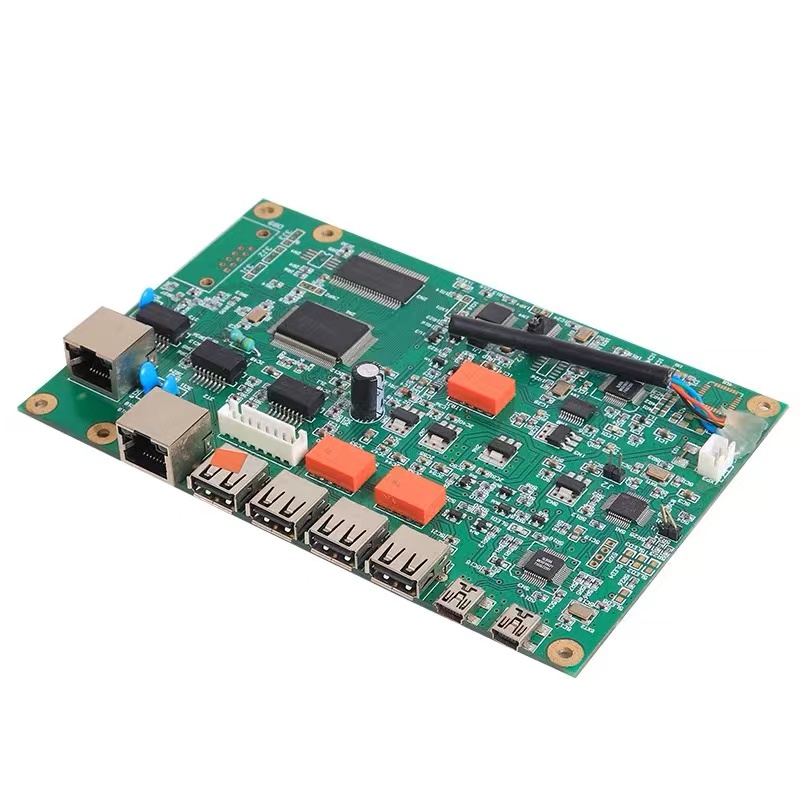
PCB: The Core Platform of Thermal Imaging Thermometers
Within a thermal imaging thermometer, the PCB functions as the system’s structural and electrical backbone. Its role extends far beyond simple component mounting.
1. High-Precision Signal Transmission and Processing
The infrared detector captures minute thermal radiation differences and converts them into weak electrical signals. These signals must be amplified, filtered, digitized, and processed by a microprocessor or image processor.
The PCB provides controlled impedance routing between the infrared sensor, analog front-end circuits, analog-to-digital converters (ADC), and processing units. High-quality multilayer PCB structures reduce electromagnetic interference and signal noise, ensuring stable data transmission.
Accurate temperature calculation and image clarity rely on this signal integrity. Even minor layout flaws or grounding issues can lead to drift, noise, or measurement deviation.
2. Integration, Miniaturization, and System Coordination
Modern thermal imaging thermometers are designed to be portable, compact, and suitable for fixed installations or handheld operation. High-density interconnect (HDI) PCBs enable dense component placement and fine-line routing, allowing integration of:
- Power management circuits
- Image processing units
- Display driver ICs
- Communication modules such as Wi-Fi or Ethernet
- Memory and control units
This level of integration reduces system size while improving electrical performance and coordination between subsystems. Shorter signal paths also enhance reliability and reduce latency in real-time thermal imaging.
3. Thermal Management and Environmental Stability
Although the device measures temperature, its internal electronics generate heat that must be carefully controlled. Thermal instability can introduce sensor drift and reduce measurement accuracy.
Metal-core PCBs or thermally optimized multilayer boards help dissipate heat from processors and power components. Proper copper thickness selection and thermal via design further improve heat distribution.
In addition, protective surface treatments and conformal coatings enhance resistance to humidity, oxidation, and frequent use in public environments. These factors extend product lifespan and maintain long-term measurement stability.
Additional PCB Considerations in Thermal Imaging Design
To achieve medical-grade or industrial-grade reliability, several additional PCB factors are critical:
- Low noise analog design to protect weak sensor signals
- Stable grounding architecture separating analog and digital domains
- EMI/EMC optimization to prevent interference from surrounding electronics
- High reliability materials suitable for continuous operation
- Consistent manufacturing quality control to ensure repeatable performance
In large-scale public screening scenarios, equipment must operate continuously for extended periods. PCB durability and consistency directly affect overall system uptime and maintenance frequency.
Conclusion
Infrared thermal imaging thermometers have become a key solution for high-efficiency, non-contact temperature screening in public spaces. Their ability to convert invisible infrared radiation into real-time visual temperature maps significantly improves both safety and operational efficiency.
At the heart of this technology lies the PCB. Acting as the system’s structural framework, signal highway, and thermal management platform, the PCB determines measurement accuracy, stability, and long-term reliability.
As thermal imaging devices continue to evolve toward higher resolution, greater portability, and enhanced connectivity, PCB technology will remain the foundational driver enabling improved performance and dependable operation.