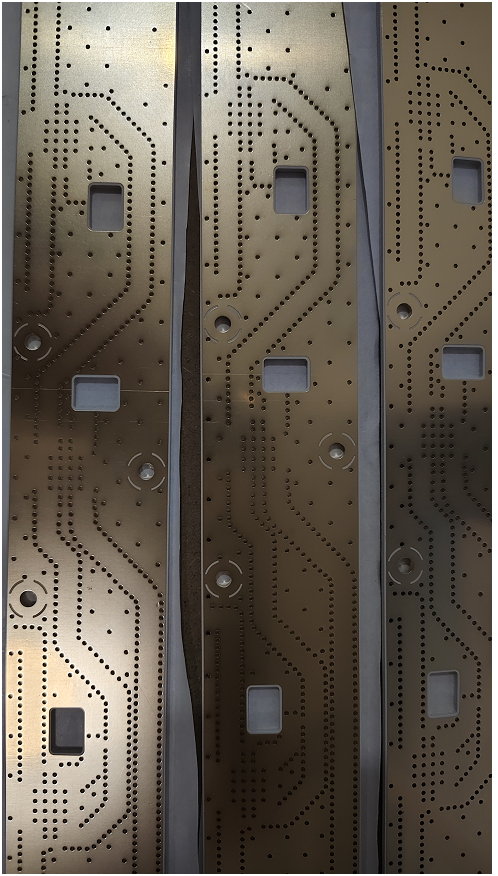
Rogers material: RO3203 with balanced and excellent comprehensive performance, it has become a “universal benchmark” for high-end application scenarios such as 5G, satellite communication, and radar systems, providing stable and reliable solutions for high-frequency signal transmission.
Rogers material: RO3203 Core Strengths
Originating from its precise material formula and structural design. It uses high-performance fluorocarbon resin as the substrate, supplemented by glass fiber reinforcement layer, to form a composite structure that combines flexibility and rigidity.
Its dielectric constant (ε r) remains stable at 3.0 and fluctuates minimally over a wide frequency range (1GHz-40GHz), ensuring consistency in signal transmission speed; At the same time, the dielectric loss (tan δ) is as low as 0.0013, which can minimize signal attenuation and provide protection for long-distance, high-definition and high-frequency communication. The excellent performance of these two key indicators makes it a core material for solving the problem of high-frequency signal distortion.
In terms of extreme environmental adaptability, RO3203 exhibits strong stability. It can maintain stable performance within a wide temperature range of -40 ℃ to 150 ℃, and can handle both low temperature environments of high-altitude satellite equipment and high temperature conditions of industrial radar with ease. In addition, the material also has excellent chemical corrosion resistance and flame retardancy, meeting the UL94 V-0 flame retardant standard, balancing safety and service life, and widely suitable for harsh fields such as aerospace and automotive electronics.
In terms of processing and application, RO3203 also performs outstandingly. Its excellent dimensional stability and anti warping ability can accurately match the drilling, etching and other processing techniques of precision PCBs (printed circuit boards), effectively reducing production errors and improving product yield.
At present, RO3203 has been deeply applied in core components such as 5G base station antenna arrays, millimeter wave radars, and satellite communication receivers, becoming a key material for promoting the landing of high-frequency technology.
Prospects and Development
With the acceleration of 6G technology development and the widespread adoption of the Internet of Things, the demand for high-frequency materials will continue to explode. ROGERS RO3203, with its mature technology, stable performance, and wide applicability, not only currently holds a mainstream position in the market, but also will continue to play a “performance cornerstone” role in the future development of the high-frequency communication industry, helping to promote innovation and upgrading in the global technology industry.