Immersion silver PCB is a type of printed circuit board that uses a thin, chemically deposited layer of silver over exposed copper pads. This surface finish protects copper from oxidation while delivering a flat, highly conductive surface for component assembly. Because of its excellent planarity and electrical performance, immersion silver has become a preferred option for high-frequency, fine-pitch, and high-speed electronic designs.
What Is Immersion Silver and How It Works
Immersion silver is formed through a controlled chemical displacement reaction. During fabrication, silver ions replace a very thin layer of surface copper, creating a uniform metallic coating directly bonded to the copper trace.
The process typically includes:
First, thorough cleaning and micro-etching of the copper surface to remove contaminants and oxides. This preparation step is critical for ensuring strong adhesion and coating uniformity.
Next, the PCB is immersed in a silver plating bath. Through a controlled chemical reaction, a thin silver layer—typically between 0.1–0.4 µm—is deposited evenly across exposed copper areas.
Finally, the board is rinsed, dried, and often treated with anti-tarnish protection to enhance shelf life and handling stability.
Because the silver layer is deposited directly onto copper without an intermediate nickel layer, the surface remains exceptionally flat and electrically efficient.
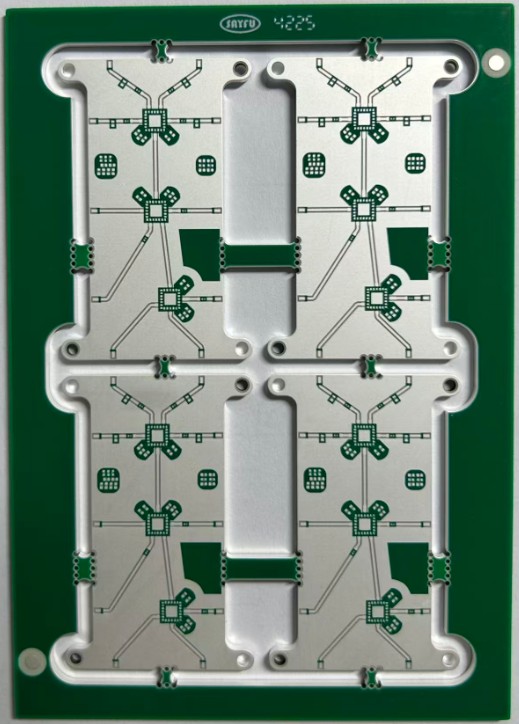
Key Advantages of Immersion Silver PCB
Immersion silver offers a well-balanced combination of electrical, mechanical, and manufacturing benefits.
It provides excellent surface planarity, making it highly suitable for fine-pitch components, BGAs, and high-density SMT assembly. Unlike uneven finishes, it supports reliable stencil printing and consistent solder paste deposition.
The finish maintains strong solderability when properly stored, allowing stable wetting performance during reflow soldering.
Electrically, immersion silver performs better than many other finishes in high-frequency and high-speed applications because there is no nickel barrier layer to introduce additional signal loss. This makes it particularly attractive for RF circuits and controlled-impedance designs.
It is also a lead-free and RoHS-compliant solution, meeting modern environmental and regulatory standards.
In addition, immersion silver is generally more cost-effective than ENIG while still offering excellent flatness and performance.
Comparison with Other Surface Finishes
When selecting a surface finish, performance requirements and application environment must be carefully evaluated.
Compared to HASL (Hot Air Solder Leveling), immersion silver offers a significantly flatter surface. HASL can create uneven thickness, which may affect fine-pitch assembly, whereas immersion silver maintains uniformity across pads.
Compared to ENIG (Electroless Nickel Immersion Gold), immersion silver eliminates the risk of “black pad” defects associated with nickel corrosion. It also avoids the additional cost of a gold layer. However, ENIG may provide longer shelf life and stronger mechanical durability in harsh environments.
OSP (Organic Solderability Preservative) is often lower cost, but it does not provide the same level of durability or multiple reflow resistance as immersion silver.
Each finish has its own strengths, but immersion silver stands out where signal integrity, flatness, and cost-performance balance are key priorities.
Limitations and Process Considerations
Although immersion silver offers many benefits, it also requires careful handling and process control.
Silver can tarnish when exposed to sulfur-containing environments or improper storage conditions. Manufacturers typically use anti-tarnish treatments and recommend vacuum packaging or nitrogen storage to extend shelf life.
Handling should be done with gloves to prevent contamination from fingerprints, which may affect solderability.
Thickness control is also important. Excessively thin coatings may reduce durability, while overly thick deposition can affect solder performance.
Therefore, selecting an experienced PCB manufacturer with strong chemical process control is essential to ensure consistent quality.
Typical Applications
Immersion silver PCBs are widely used in:
Communication infrastructure equipment
High-speed networking systems
Automotive electronics
RF and microwave circuits
High-performance computing devices
Industrial control systems
These applications benefit from the finish’s flat surface, strong conductivity, and reliable solder performance.
Industry Outlook
As electronic products continue to evolve toward higher signal speeds, smaller component pitches, and denser board layouts, surface finish requirements are becoming more demanding. Immersion silver provides a compelling combination of electrical performance, assembly compatibility, and cost efficiency.
With the growing demand for high-frequency and high-reliability designs, immersion silver PCB technology is expected to remain a strong and competitive surface finish option in the global electronics manufacturing industry.