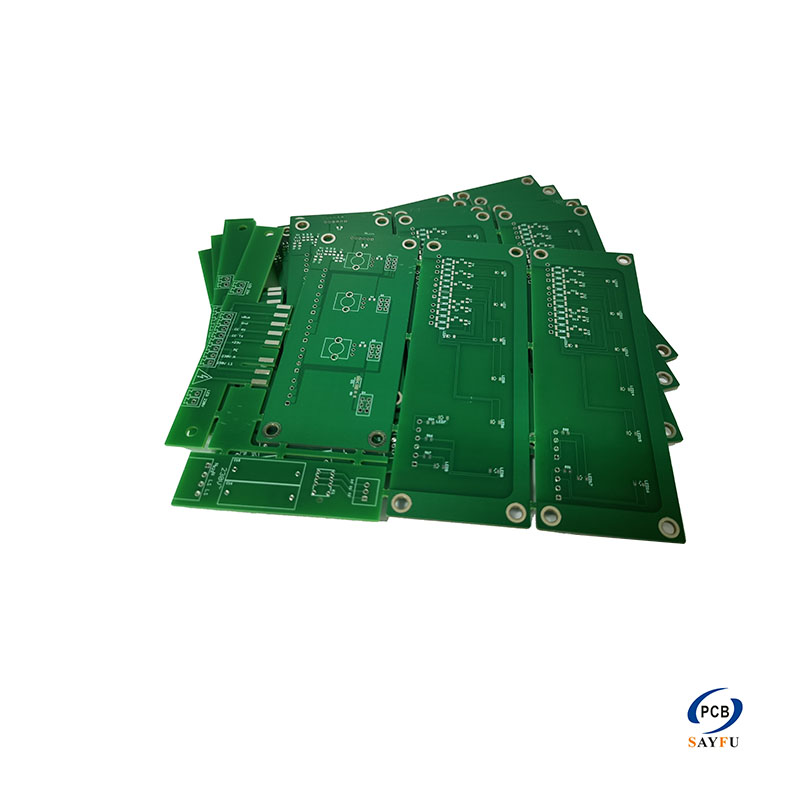
When we design a PCB, we sometimes encounter circuits with higher voltages, so how to take care of the creepage distance when designing, the following discusses this issue.
When considering the creepage distance, the relationship between voltage and distance should be considered, as well as other factors, such as humidity, temperature, air composition, pollution condition, insulating material, surface shape, location direction, etc.; therefore, when designing a PCB, if the space When conditions permit, try to enlarge the distance where problems may occur to avoid the influence of other uncertain factors.
Generally speaking, when the outer layer of the PCB is covered with green oil, the creepage distance may not be linear, and the data may be somewhat random, that is to say, 1mm may meet 1500VAC, but 2mm may only meet 1700VAC, and there are Maybe 1500VAC can’t pass the test at 1.5mm, because the supplier’s green oil coating process and ability, that is, the uneven thickness of the green oil. At present, it has been found that the reason why 1500VAC with 1.5mm spacing cannot pass is that the green oil between the signals is very thin, resulting in high voltage breakdown. Therefore, when we do PCB design, we try to take the method of increasing the spacing.
For copper foil with exposed surface, the creepage distance of 1500VAC signal is 2mm, and it is inferred that 0.3mm can satisfy 220VAC. Generally, high-speed PCB will not have too high voltage, and the design can meet the requirements by referring to the above.
For the inner copper layer, the general signal spacing of 15mil can meet 1500VAC, and the reasoning is 2mil can meet 220VAC. The PCB board factory has a minimum line spacing requirement. According to the conventional process, the minimum can be 4mil or 3.5mil. Therefore, 4mil is also That is, the 0.1mm design can generally meet the requirements, but in order to leave a margin, when designing, you can try to widen the distance between these networks with a relatively high voltage signal difference.