With microprocessor and signal conversion and transmission device running speed increase, digital circuit running speed also reached a higher level: 100Gbps. High-speed signal requirements will not be met using a generic PCB board, and the board material will determine the performance of the product.
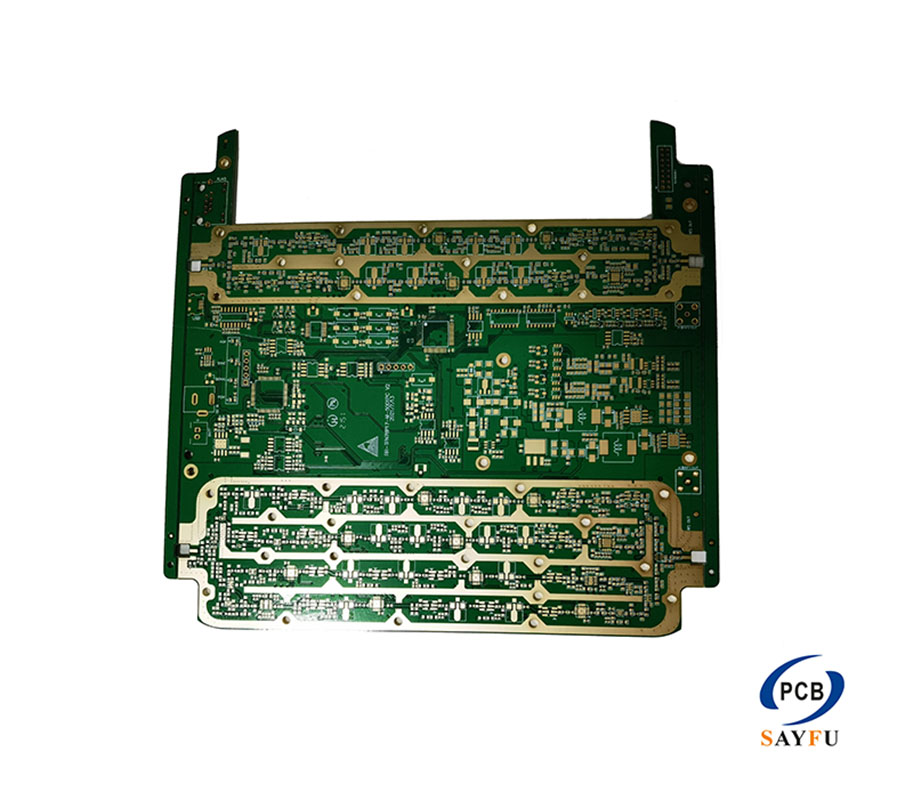
PCB board selection must meet the design requirements, mass production and cost of the balance between. In short, the design requirements consist of two components: electrical and structural reliability. This is usually important when designing very high frequency high speed board (frequencies greater than GHz). For example, the fr-4 material commonly used today may not be applicable due to its large Df(Dielectricloss) at several GHz frequencies.
For example, a 10Gb/S high-speed digital signal is a square wave, which can be regarded as a superposition of sinusoidal signals of different frequencies. Therefore, 10Gb/S contains many different frequency signals: 5Ghz fundamental signal, 3 order 15GHz, 5 order 25GHz, 7 order 35GHz signal, etc.The integrity of the digital signal and the steepness of the upper and lower edges are the same as the low loss and low distortion transmission of rf microwave (the high frequency harmonic part of the digital signal reaches the microwave band). Therefore, in many respects, the PCB material selection of high-speed digital circuits is similar to the requirements of RF microwave circuits.
In practical engineering operations, the selection of high-frequency plates seems simple, but there are still many factors to be considered. Through the introduction of this paper, AS a PCB design engineer or a high-speed project leader, I have a certain understanding of the characteristics and selection of plates. Understand electrical properties, thermal properties, reliability, etc. And rational use of stacking, design a piece of high reliability, good processing products, various factors to consider the best.
The following will introduce the main factors to consider in selecting the appropriate plate(high frequency high speed board)
- Manufacturability:
Such as multiple pressing performance, temperature performance, CAF/ heat resistance and mechanical toughness (viscosity) (good reliability), fire rating; - With the product matching performance (electrical, performance stability, etc.) :
Low loss, stable Dk/Df parameters, low dispersion, small change coefficient with frequency and environment, small tolerance of material thickness and rubber content (good impedance control), if the wire is long, consider low roughness copper foil. In addition, simulation is needed in the early stage of high-speed circuit design, and simulation results are the reference standard for design. “Xingsen Technology – Agilent (high speed/RADIO frequency) Joint laboratory” solved the performance problem of inconsistent simulation results and tests, and did a large number of simulation and actual test closed-loop verification, through a unique method to achieve the consistency of simulation and measurement. - Timely availability of materials:
Many high-frequency plate procurement cycle is very long, even 2-3 months; In addition to the conventional high frequency plate RO4350 has inventory, many high frequency plates need to be provided by customers. Therefore, high frequency plate and manufacturers need to communicate well in advance, as soon as possible; - Cost factors:
Depending on the price sensitivity of the product, whether it is a consumer product, or a telecommunications, medical, industrial, military application; - Applicability of laws and regulations, etc.
To be compatible with environmental regulations of different countries and meet the requirements of RoHS and halogen-free.
Among the above factors, the running speed of high frequency high speed board is the main factor to consider in PCB selection. The higher the circuit speed, the smaller the selected PCBDf value should be. The circuit plate with medium and low loss will be suitable for 10Gb/S digital circuit; The plate with lower loss is suitable for 25Gb/s digital circuit; Panels with ultra-low loss will accommodate faster, high-speed digital circuits at rates of 50Gb/s or higher.
From the material Df
Df between 0.01 ~ 0.005 circuit board suitable for the upper limit of 10Gb/S digital circuit;
Df between 0.005 ~ 0.003 circuit board suitable for the upper limit of 25Gb/S digital circuit;
Circuit boards with Df not more than 0.0015 are suitable for 50Gb/S or higher speed digital circuits.
Commonly used high frequency high speed plates are
1), Rogers: RO4003, RO3003, RO4350, RO5880, etc
2), Taiyao TUC:Tuc862, 872SLK, 883, 933, etc
3), Panasonic: Megtron4, Megtron6, etc
4), Isola: FR408HR, IS620, IS680, etc
5) Nelco: N4000-13, N4000-13EPSI, etc
6), Dongguan Shengyi, Taizhou Wangling, Taixing Microwave, etc
Of course, there are many other high-frequency boards, such as Arlon(acquired by Rogers last year), Taconic, are old brand RF microwave board manufacturers, performance is guaranteed.
The above overview of how to choose high-speed plate and design matters needing attention, the actual application should be analyzed according to specific cases.